

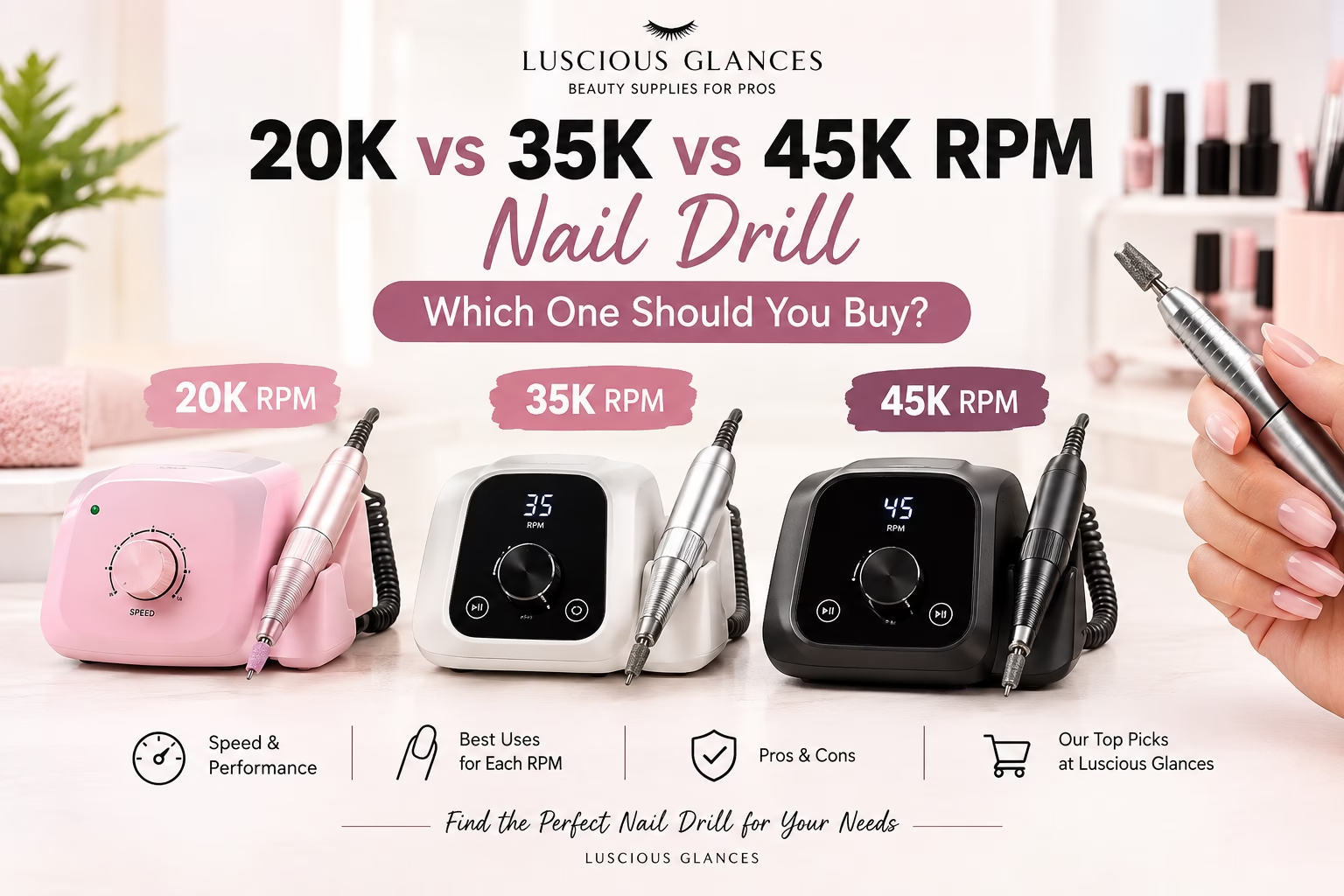
20K vs 35K vs 45K RPM Nail Drill Which One Should You Buy
Choosing the right nail drill is important for beginners, nail technicians, salon professionals, and anyone working regularly with gel, acrylic, builder gel, or nail extensions. One of the first specifications you will notice when shopping for an electric nail drill is its maximum speed, usually shown as 20K, 35K, or 45K RPM.
But does a higher RPM automatically mean a better nail drill?
Not necessarily. RPM means revolutions per minute, or how many times the drill bit rotates in one minute. A higher maximum RPM gives you more capacity for demanding work, but the correct working speed depends on the product, bit, technique, and experience level. Current nail-tech guidance emphasizes control, appropriate bits, light pressure, and avoiding excessive heat rather than simply choosing the highest RPM.
For nail technicians, the real question is:
Should you buy a 20,000 RPM, 35,000 RPM, or 45,000 RPM nail drill?
Let’s compare all three in detail.
What Does RPM Mean in a Nail Drill?
RPM = Revolutions Per Minute.
For example:
- 20K RPM = maximum 20,000 rotations per minute
- 35K RPM = maximum 35,000 rotations per minute
- 45K RPM = maximum 45,000 rotations per minute
A nail drill with a higher maximum RPM doesn’t mean that you should operate it at that speed all the time.
In fact, delicate work generally requires considerably lower speeds. Depending on the task and equipment, nail-tech guidance commonly places delicate prep and cuticle work at lower speeds, while bulk enhancement removal can require higher speeds.
The advantage of a higher-RPM machine is therefore additional operating headroom, not a requirement to use maximum speed.
20K vs 35K vs 45K Nail Drill at a Glance
| Feature | 20K RPM | 35K RPM | 45K RPM |
|---|---|---|---|
| Maximum speed | 20,000 RPM | 35,000 RPM | 45,000 RPM |
| Beginners | Excellent for basic work | Good with proper training | Usually unnecessary initially |
| Natural nail work | Suitable with proper technique | Suitable at controlled low speed | Suitable only at appropriate low speed |
| Gel removal | Good | Excellent | Excellent |
| Acrylic removal | Suitable for lighter work | Excellent | Excellent |
| Heavy enhancement work | Limited | Very good | Very good |
| Salon use | Basic/moderate | Professional | Advanced/high-capacity |
| Learning curve | Lower | Moderate | Higher |
| Future upgrade potential | Moderate | High | Very high |
| Main advantage | Simplicity | Balance of power and versatility | Maximum speed capacity |
These are broad comparisons rather than universal operating prescriptions. The appropriate speed changes according to the bit, material, pressure, machine torque and technician’s control.
20K RPM Nail Drill
A 20,000 RPM nail drill can be a practical option for beginners, home users, students, and nail technicians who mainly perform lighter nail services.
It provides enough speed for many everyday tasks without necessarily requiring the additional capacity of a 35K or 45K machine.
Where a 20K Drill Can Be Useful
A 20K nail drill can be used for tasks such as:
- Nail shaping
- Basic gel removal
- Surface refinement
- Light enhancement work
- Smoothing
- Manicure preparation
- Basic salon services
For natural nails and delicate areas, you would normally operate far below the machine’s maximum speed.
Some current guides place natural-nail and delicate work substantially below 20,000 RPM, reinforcing that maximum RPM and working RPM are two different things.
Advantages of 20K
1. Beginner-friendly
If you are learning how to control an e-file, a lower maximum speed can make the machine less intimidating.
2. Suitable for basic nail services
For users who don’t regularly remove thick acrylic or perform high-volume enhancement services, 20K can cover many everyday requirements.
3. Lower cost potential
Machines with lower maximum speeds can sometimes provide a more economical entry point.
Limitations of 20K
The biggest limitation is less room to grow.
If you eventually start doing:
- Heavy acrylic removal
- Frequent extension removal
- High-volume salon work
- Thick enhancement reduction
- More demanding professional services
you may eventually want a more powerful machine.
Who Should Consider 20K?
A 20K drill can make sense for:
- Beginners
- Students
- Home users
- Occasional nail technicians
- Basic manicure services
- Users who don’t regularly work with thick enhancements
35K RPM Nail Drill
A 35,000 RPM nail drill sits in the middle of the three options and offers considerably more speed capacity than a 20K model.
Professional e-files commonly operate around the 30K–35K range, although the actual working speed should still be adjusted to the specific service.
For many nail technicians, the main attraction of 35K is versatility.
Why 35K Is Popular for Professional Nail Work
A 35K machine can provide enough capacity for:
- Gel removal
- Acrylic removal
- Builder gel work
- Nail extension shaping
- Bulk product reduction
- Refining enhancements
- Salon work
- Professional nail services
Importantly, having 35K available doesn’t mean running at 35K continuously.
A professional technician may use a much lower setting for delicate work and increase speed when removing bulk product.
Advantages of 35K
1. Versatility
You have a wider operating range for different services.
2. Professional capability
35K falls within the maximum-speed range of many professional e-files.
3. Room to grow
A beginner who eventually becomes a professional nail technician may find 35K gives them more flexibility without immediately moving to a 45K machine.
4. Better suited to regular enhancement work
If you regularly work with acrylic, gel extensions, or other enhancement products, the additional speed capacity can be useful.
Who Should Consider 35K?
A 35K drill is worth considering for:
- Professional nail technicians
- Nail salons
- Technicians working regularly with acrylic
- Gel and builder-gel users
- Extension specialists
- Technicians looking for a versatile long-term machine
45K RPM Nail Drill
A 45,000 RPM nail drill provides the highest maximum speed among the three options in this comparison.
However, it’s important to understand what that number actually means.
45K does not mean you should use 45,000 RPM for every service.
The maximum rating represents the machine’s available speed capacity. Your actual working speed should be selected based on the material, bit, location, technique, and experience.
Recent e-file guidance specifically notes that a 45K rating is a ceiling rather than the speed you will necessarily use during normal work.
Advantages of 45K
1. Maximum speed capacity
You have more speed available when your work requires it.
2. Suitable for advanced users
Experienced technicians who understand bit selection, pressure, movement and heat management can make use of a broader speed range.
3. Heavy-duty potential
For technicians who regularly perform demanding enhancement removal and shaping, the additional capacity may be useful.
4. Future-proofing
If your nail business is growing and your services are becoming more advanced, a higher-capacity machine can reduce the need for an early upgrade.
The Important Limitation
A 45K machine isn’t automatically better simply because the number is higher.
A nail drill’s torque, vibration, handpiece quality, speed control, bit compatibility and ergonomics can be more important to the actual working experience than maximum RPM alone.
20K vs 35K vs 45K Which Is Better?
There isn’t one RPM that is correct for everyone.
Instead, think about your experience and the type of nail work you perform.
Choose 20K if:
- You are a beginner
- You mostly do basic nail work
- You work primarily at home
- You don’t regularly remove thick acrylic
- You want a simple entry-level machine
Choose 35K if:
- You are a professional nail technician
- You regularly work with gel and acrylic
- You perform nail extensions
- You want one versatile machine
- You expect your skills and services to grow
Choose 45K if:
- You are an experienced professional
- You regularly perform demanding enhancement work
- You understand e-file technique
- You need additional maximum-speed capacity
- You prioritize professional-level flexibility
What RPM Should You Actually Use?
This is one of the most important points in this entire guide.
You should not select your working speed simply because your drill can reach 20K, 35K, or 45K.
Different services require different speeds.
A broad educational framework is:
| Nail Work | General Speed Approach |
|---|---|
| Natural nail/delicate work | Low speed |
| Cuticle/detail work | Low speed |
| Refining | Low to medium |
| Gel reduction | Medium |
| Acrylic/product removal | Medium to higher |
| Heavy enhancement reduction | Higher, for experienced users |
Published e-file guidance gives different numerical ranges depending on the bit and task, but consistently emphasizes starting conservatively and adjusting according to the service and control.
Always follow the instructions supplied with your specific drill and bit.
Does Higher RPM Remove Product Faster?
Potentially, but RPM is only one part of the equation.
The actual performance of a nail drill also depends on:
- Motor torque
- Bit type
- Bit grit
- Product thickness
- Technician technique
- Pressure
- Machine quality
- Vibration
- Speed stability
For example, a well-built 35K machine with good torque and stable speed can perform better in real-world use than a poorly designed 45K machine.
One current nail-tech guide specifically highlights torque under load as a major factor because a drill that slows significantly under pressure can encourage the user to press harder.
Why Torque Matters
Torque is the machine’s ability to maintain rotational force when the bit encounters resistance.
This is especially important when working with thicker nail enhancements.
A machine with a high RPM rating but poor performance under load may slow down when it contacts product.
A good professional machine should provide:
- Stable rotation
- Smooth speed control
- Good torque
- Low vibration
- Comfortable handpiece
- Reliable chuck
- Appropriate bit compatibility
Therefore, don’t buy a nail drill based only on the number printed on the box.
Vibration Is Also Important
If a nail drill vibrates excessively, precision work becomes more difficult.
This can be especially noticeable during:
- Cuticle-area work
- Sidewall refinement
- Detailed shaping
- Long salon sessions
A comfortable, well-balanced handpiece can make a significant difference to a technician who uses the drill throughout the day.
When comparing nail drills, hold the handpiece if possible and check:
- Weight
- Balance
- Grip
- Vibration
- Noise
- Heat
- Ease of speed adjustment
Forward and Reverse Direction
A good professional nail drill should ideally have forward and reverse rotation.
This gives the technician more control when working from different angles and on different sides of the nail.
The correct direction depends on your hand position, the working surface, and the bit being used.
For professional nail technicians, forward/reverse functionality is therefore an important feature to consider.
Don’t Forget the Nail Drill Bits
Buying a powerful nail drill is only part of the setup.
The bit you use is equally important.
Different bits are designed for different purposes, including:
- Diamond bits
- Carbide bits
- Ceramic bits
- Safety bits
- Mandrel bits
- Sanding bands
- Fine-detail bits
A coarse bit designed for product removal should not automatically be used on the natural nail.
The correct combination is:
Machine + RPM + bit + pressure + technique
not simply:
Higher RPM = better result.
Current safety guidance emphasizes selecting the correct bit for the material and keeping the bit moving rather than holding it in one place.
Common Nail Drill Mistakes Beginners Should Avoid
1. Starting at Maximum RPM
Never assume that the fastest setting is the best setting.
Start at a controlled speed appropriate for the task and increase only when you have the necessary control.
2. Pressing Too Hard
Let the bit do the work.
Excessive pressure can increase friction and heat and make the service uncomfortable.
3. Staying in One Place
A rotating bit held in one location can create excessive heat.
Keep the bit moving with controlled strokes.
4. Using the Wrong Bit
A coarse bit and aggressive technique can cause unnecessary damage, particularly near the natural nail.
5. Treating Every Nail the Same
Different products, thicknesses, nail conditions, bits and service steps require different approaches.
6. Buying Based Only on RPM
A 45K label doesn’t tell you:
- How smooth the motor is
- How much torque it has
- How much it vibrates
- How accurately the speed is controlled
- How comfortable the handpiece is
These factors matter greatly in professional work.
20K vs 35K vs 45K for Different Users
For Beginners
A 20K machine may be enough for basic learning and lighter nail services.
However, a beginner can also use a higher-rated machine if it provides precise low-speed control and the user receives proper training. A higher maximum speed does not have to be used immediately.
For Intermediate Nail Technicians
A 35K machine provides additional flexibility as your services expand.
It can be a practical choice if you’re moving from basic manicures toward regular gel, acrylic, and extension work.
For Professional Nail Technicians
A 35K or 45K machine can provide the additional capacity required for demanding salon work.
At this level, however, machine quality becomes increasingly important.
For High-Volume Salons
Look beyond RPM.
Consider:
- Motor durability
- Torque
- Vibration
- Handpiece weight
- Heat
- Speed stability
- Bit compatibility
- Forward/reverse operation
- Warranty and service
What Should You Look for When Buying a Nail Drill?
Before purchasing a nail drill from Luscious Glances or any other supplier, check these features.
1. Variable Speed Control
A variable-speed dial or controller allows you to adjust the drill according to the service.
This is more useful than simply having a high maximum RPM.
2. Forward and Reverse
Especially useful for professional nail technicians.
3. Good Handpiece
Look for a comfortable, balanced handpiece that doesn’t cause excessive vibration.
4. Good Torque
The drill should maintain consistent performance when working against product resistance.
5. Compatible Bits
Check the bit size and compatibility before purchasing replacement bits.
6. Low-Speed Control
This is extremely important for beginners and delicate work.
7. Heat and Vibration
A machine that becomes excessively hot or vibrates heavily may be uncomfortable during long sessions.
8. Reliable Build Quality
For salon professionals, durability and service support can be more important than simply choosing the highest RPM.
20K vs 35K vs 45K Which Nail Drill Should You Buy?
The answer depends on what you need.
20K Nail Drill
Best suited for: Beginners, home users and basic nail work.
Choose 20K when you want a straightforward machine for lighter services and don’t expect to perform heavy enhancement removal regularly.
35K Nail Drill
Best suited for: Professional nail technicians and growing salons.
A 35K machine provides a useful combination of speed capacity and versatility for gel, acrylic and nail-extension work.
45K Nail Drill
Best suited for: Experienced professionals who want maximum speed capacity.
Choose 45K when your work genuinely benefits from the additional available speed and you already have good e-file control.
Is a 45K Nail Drill Better Than a 35K?
Not automatically.
A 45K nail drill has a higher maximum RPM, but that doesn’t mean it will produce better results in every situation.
For many professional services, the technician may work substantially below the maximum speed.
In practice, a well-designed 35K nail drill with strong torque, low vibration and precise speed control may be more useful than a lower-quality 45K machine.
The important question isn’t:
“Which drill has the highest RPM?”
It is:
“Which drill gives me the right combination of speed, control, torque and comfort for my work?”
Luscious Glances Nail Drill Range
At Luscious Glances, nail technicians and salon professionals can choose from nail equipment designed for different levels of nail work, including 20K, 35K and 45K RPM nail drills.
Whether you are starting your nail-extension journey or upgrading your professional salon setup, consider your current services, experience level and future requirements before selecting your machine.
A good nail drill can make product removal, shaping and refinement more efficient—but the best results still depend on correct training and technique.
Final Verdict
There is no single RPM that is perfect for every nail technician.
20K RPM can be suitable for beginners and lighter nail work.
35K RPM offers a versatile option for professional nail technicians working regularly with gel, acrylic and nail extensions.
45K RPM provides additional maximum-speed capacity for experienced professionals and demanding applications.
Most importantly, don’t choose a nail drill only because it has the highest RPM. Look at speed control, torque, vibration, handpiece quality, bit compatibility and your own experience.
And remember: higher RPM does not mean higher quality. Better control does.
With the right nail drill, correct bit, appropriate speed and proper technique, you can work more efficiently while maintaining better control over your nail services.
Luscious Glances provides professional nail extension supplies and equipment to help nail technicians and salons build a complete, reliable nail setup.

 luscious glances with model](https://lusciousglances.in/wp-content/uploads/2026/10/Gemini_Generated_Image_qwewisqwewisqwew-300x173.avif)